Engineered Wood Floor Fitter Hullbridge SS5 — What Actually Goes Into the Job
Engineered Wood Floor Fitter Hullbridge SS5 — What Actually Goes Into the Job
If you live in Hullbridge or anywhere in the SS5 area and you're thinking about engineered wood floors, the first thing you need to know is that the fitting is as important as the product. I've been laying floors across Essex since 1982 — Graham Holmes — and the jobs that go wrong almost always come down to one of two things: the wrong board for the subfloor, or the wrong preparation before the first plank goes down.
Hullbridge is a village I know well. It sits on the River Crouch, and most of its housing stock is bungalows and 1970s semis — buildings with their own particular subfloor habits. Before you start browsing oak samples online, it's worth understanding what's underneath and why it matters.
Book a survey for your Hullbridge home — WhatsApp me first and we'll arrange a time.
Engineered Wood vs Solid Wood — the Short Version
Solid wood is exactly what it sounds like: a plank milled from a single piece of timber, anything from 18mm to 22mm thick. It looks beautiful and can be sanded back multiple times over decades. The downside is that it moves — a lot — in response to changes in heat and humidity. Lay it where moisture or temperature swings, and you'll be looking at gaps, cupping, or squeaking within a year.
Engineered wood has a wear layer of real hardwood on top — the part you see, sand, and live on — bonded to a stable core of cross-ply or HDF beneath. The core resists the movement that kills solid boards. That makes engineered the sensible choice for most homes in the SS5 area: bungalows with concrete ground floors, older houses where the underfloor heating has been retrofitted, rooms that face the garden and catch afternoon sun.
The wear layer thickness matters. A 3mm top layer can be lightly sanded once, maybe twice. A 6mm layer gives you proper longevity — closer to the behaviour of solid wood over its lifetime.
What Hullbridge Subfloors Are Actually Like
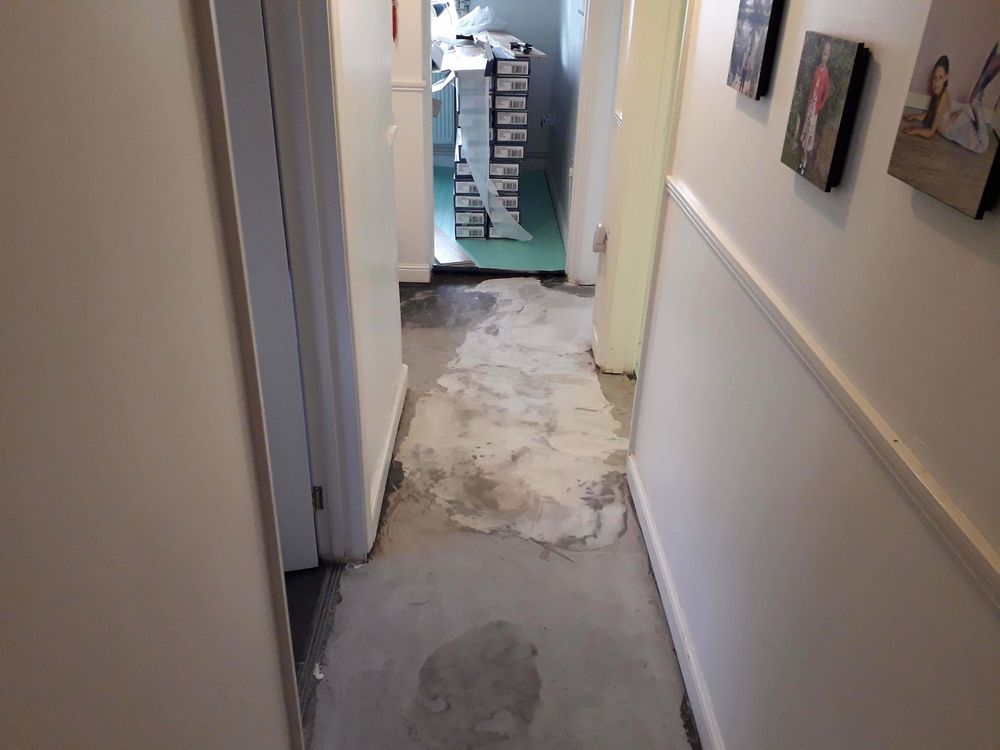
Most ground floors in Hullbridge bungalows are solid concrete — poured slab or early beam-and-block. Concrete isn't flat by default, and it certainly isn't flat after 50 years. Bumps of more than 3mm over a 2-metre span will telegraph through the boards and cause them to rock, creak, or break at the locking joints under foot traffic.
The fix is a self-levelling compound, applied after priming — it flows into the low spots, levels off, and cures to a hard surface the boards can bond or float over. It adds time and cost, but skip it and you'll regret it.
First floors in 1970s semis are usually suspended timber — a sub-frame of joists with floorboards on top. Timber flexes. That flex is fine for carpet, which moves with it, but engineered wood needs a stable, firm base. If the existing boards are loose or springy, they need securing before anything new goes down. Sometimes we lift and replace problem boards; sometimes we overlay with a sheet of quality plywood to create a consistent surface. How to prep a subfloor for LVT covers the same principles, and much of it applies here too.
If you're over towards Battlesbridge — which sits right on the CM3 and SS11 border — the mix of older agricultural cottages and converted buildings means the subfloor situation can be genuinely unpredictable. I've lifted carpet in Battlesbridge to find original flagstones, sand, or a concrete raft that was clearly poured in stages. Survey first, always.
The Fitting Process — Step by Step
Survey. I come out, look at the room, assess the subfloor, measure for materials, and discuss the product range. No appointment fees, no obligation — WhatsApp me and we'll fix a time.
Acclimatisation. Engineered wood needs to adjust to the temperature and humidity of your home before it goes down — typically 48 to 72 hours in the room where it'll be fitted. Skipping this is one of the more common mistakes I see when people have work done by fitters who are in a hurry.
Subfloor preparation. Levelling compound where needed, securing loose boards, damp-proofing membrane on concrete if required. This stage takes as long as it takes — rushing it is false economy.
Laying. Most engineered wood is either glued down or floated (clicked together over underlay, not fixed to the base). Which method suits your floor depends on the subfloor type, the board width, and whether you have underfloor heating. I'll specify the right approach at survey.
Finishing. Threshold strips where the floor meets adjacent rooms, beading or re-fitting skirting at the perimeter, a final check to make sure every joint is tight and every board lies flat. The edges are where the amateur jobs show — neat skirting work is something I take seriously.
For a rough sense of material quantities before we get into specifics, the flooring calculator at howmuchdoineed.co is worth a look — it'll give you a ballpark on how many square metres you're ordering. And if you're not sure how to measure an L-shaped room or one with a bay, this guide on measuring a room for flooring will walk you through it.
Nearby Areas I Cover
As a floor fitter covering Essex broadly, I work across the area regularly. If you're in South Woodham Ferrers (CM3), over in Wickford (SS11), or out towards Rayleigh (SS6), I'm out that way most weeks. Hullbridge and the surrounding SS5 villages — Hockley, Ashingdon — are squarely in the area I cover. Same professional standard, same approach, regardless of where you are.
What to Ask Any Floor Fitter Before You Book
A few questions worth putting to any fitter before you commit:
- Do you survey the subfloor first, or just quote from measurements? Any decent fitter surveys. Quoting blind leads to surprises on the day.
- Are you fitting full-time, or is flooring a sideline? It shows in the work.
- How long have you been fitting engineered wood specifically? Solid wood and carpet experience doesn't automatically transfer to the precision engineered installation demands.
- Who handles the prep work — you or a subcontractor? I do my own prep. The person who lays the levelling compound should be the same person who lays the floor over it.
I've been doing this in Essex since 1982. Hullbridge, South Woodham Ferrers, Wickford, Rayleigh — I know the housing stock, I know the subfloor types, and I know what can go wrong before it does.
WhatsApp me with your room size, floor type, and rough timescale: https://wa.me/447966350111
Frequently asked questions
Can engineered wood go over underfloor heating in Hullbridge homes?
Yes — engineered wood is designed for it, unlike solid wood, because the layered construction handles the heat cycles without cupping or gapping. You need a board specifically rated for UFH and the right maximum surface temperature (usually 27°C). Tell me before I survey so I can spec the right product.
Can you fit engineered wood over existing floor tiles?
Sometimes. The tiles need to be solid, level, and not hollow anywhere underfoot. If they're lifting, hollow, or uneven, they have to come up first — fitting over a broken base just transfers the problem upward. I'll tell you on the survey exactly what we're dealing with.
How long does an engineered wood floor fitting take in a typical Hullbridge bungalow?
A single through-lounge or open-plan kitchen-diner — typically one to two days depending on subfloor condition. Add half a day if we're doing levelling compound. I'll give you a realistic timeline when I've seen the room.
Is engineered wood a good choice if we have dogs?
A harder species — oak, ash, walnut — in a brushed or matt lacquered finish holds up well to claws and the odd accident better than you'd expect. Gloss finishes show every scratch and every paw print. I'd steer most dog-owners toward a robust oiled finish or a tough UV lacquer rather than a soft wax.
How far in advance do I need to book?
Demand varies. WhatsApp me with your rough timescale and I'll tell you what's available. Some jobs I can slot in quickly; others need a bit more lead time, especially if the subfloor needs prep work first.
Want a hand with your floors?
Message Graham on WhatsApp with a few details about your rooms and what you’re after.
More flooring guides
Laminate Floor Fitter in Wickford SS11 — What to Expect (and What Most People Get Wrong)
Laminate flooring in Wickford done properly — what the prep involves, how to choose the right thickness, and what actually affects the price in the SS11 area.
LVT & VinylVinyl Floor Fitter in Maldon, CM9 — What Actually Goes Into the Job
Graham Holmes has been fitting vinyl and LVT floors across Maldon, CM9 and the surrounding area since 1982. Here's what the job actually involves — from subfloor prep to the questions worth asking before you book.
Wood FloorsEngineered Wood Floor Fitter Essex — What You Should Know Before You Book
Engineered wood is one of the most satisfying floors to fit — when it's done right. Here's what to look for, what to expect, and why preparation is everything.